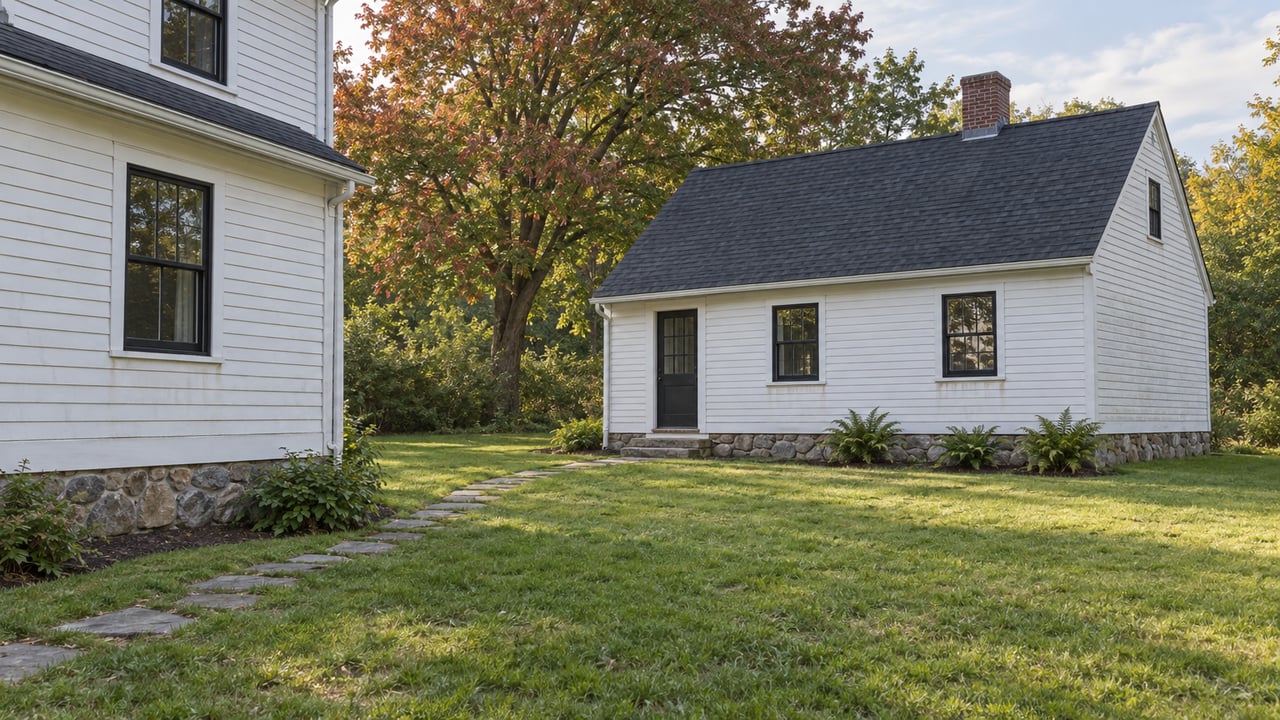
Walk through a 1958 cape in Dover and a nearly identical cape built in 1975 six miles away in Rochester, and a buyer might reasonably assume the same rules apply to both. New Hampshire passed a law last year that was supposed to make that true. It didn't, not entirely, and the gap between what the state promised and what a specific town will actually let you build is where a lot of buyers get surprised after closing.
The law is HB 577, signed by Governor Ayotte and effective July 1, 2025. It requires every New Hampshire municipality to allow one accessory dwelling unit, attached or detached, as a matter of right on any lot zoned for a single-family home. That sounds like a floor everyone stands on equally. In practice it's a floor with a different shape in every Strafford County town, because the law also hands towns a list of carve-outs: they can cap the size, they can require the owner to live on site, they can block ADUs on leased land, and they can refuse to let an ADU be sold off separately from the main house. Three Strafford County towns have used that latitude in three different ways, and none of it shows up on a listing sheet.
Dover's Bigger, Older Right
Dover is fully sewered, which already sets it apart from most of the county, and the city layers the new state law on top of a local rule that predates it by decades. According to the city's own planning FAQ, any Dover home built before May 1964 can convert to a full two-family dwelling by right, not just a subordinate ADU. That's a broader right than HB 577 grants anywhere else in the state, and it has nothing to do with the 2025 law. It's a pre-existing nonconforming use provision tied entirely to a construction date.
A Dover ADU applicant still owes the city an impact fee, according to that same FAQ, and the city has been mid-rewrite on its own zoning code this year. The Planning Board posted its 2026 amendments in late July and held public hearings on September 8 and September 22, which means the ordinance a Dover buyer read over the summer may already differ from what's on the books now. Anyone evaluating a Dover property for in-law or rental potential should ask the Planning Department directly which version of the code applies to a specific address, not just pull the online zoning table and assume it's final.
Strafford's Septic Ceiling
Move northwest into the Town of Strafford, a rural, unsewered community, and the picture changes completely. The town's Planning Board spent its winter rewriting Article 1.4.1.K of the zoning ordinance to comply with HB 577, holding public hearings on January 6 and January 21, 2026. The new rule allows one attached or detached ADU as a matter of right, same as the state requires, and raises the maximum size to 950 square feet on a conforming lot or 750 square feet on a non-conforming one. It also lets a homeowner convert an existing structure, including a detached garage, into an ADU even if that structure doesn't meet current setback or lot-coverage standards.
The provision that actually matters more than the square footage cap is the septic language. The ordinance requires an ADU applicant to make adequate provision for water supply and sewage disposal in accordance with state law, but state law is explicit that a municipality cannot require a separate septic system for the ADU beyond what NH Department of Environmental Services rules already demand for the property. That sounds like a win for homeowners, and for some it is. But it doesn't create septic capacity where none exists. If a lot's existing system was designed and approved for a three-bedroom house, the state law removes the town's ability to pile on extra local septic requirements. It does not remove the physical limit of the tank and leach field already in the ground. In a town with no sewer connection anywhere, that limit is the real ceiling on whether an ADU is buildable, regardless of what the zoning ordinance now allows.
Rochester Was Already There
Rochester's version of this story is quieter, because the city didn't need a full rewrite. Its zoning code already contained a standalone accessory apartment ordinance, listed under Section 275-23.2 of the city code, with its own set of standards for accessory apartments before HB 577 forced statewide alignment. That means Rochester's adjustment to the new law is more of a reconciliation between an existing local ordinance and a new state floor, rather than the from-scratch rewrite Strafford undertook. For a buyer, that translates into a more settled set of rules right now, though it's worth confirming with the city's planning office whether any 2026 updates have been made to align the older ordinance with HB 577's specific size and by-right provisions.
The Leased Land Exception
One more carve-out in the state law deserves attention from a specific slice of buyers. HB 577 allows a municipality to prohibit ADUs associated with rented or leased land. That matters directly for anyone considering a manufactured home on a leased lot, a common and often more affordable path into homeownership across Strafford County. The by-right ADU guarantee that applies to a homeowner on a fee-simple lot doesn't automatically extend to a manufactured home community where the land itself is leased rather than owned. Whether an ADU is possible in that setting depends on how the specific town has chosen to treat leased-land parcels, and that answer has to come from the town, not from the state law's headline.
Here's what those three towns add up to. State law is a promise that gets modified, in three visibly different directions, before it reaches an individual buyer:
| Town | Sewer or septic | Local rule that changes the math | 2026 status |
|---|---|---|---|
| Strafford | Septic only | No separate septic required beyond DES rules, but existing system capacity still caps unit size in practice | Ordinance rewrite went through public hearings Jan. 6 and Jan. 21, 2026 |
| Dover | City sewer | Homes built before May 1964 qualify for a full two-family conversion, a broader right than a standard ADU, plus a city impact fee | Planning Board held public hearings Sept. 8 and Sept. 22, 2026 on further amendments |
| Rochester | City sewer | Pre-existing accessory apartment ordinance under city code Section 275-23.2 predates HB 577 | Reconciling an established local ordinance with the new state floor |
Questions Worth Asking Before You Assume the In-Law Potential Is Real
A listing that mentions ADU or in-law potential is describing a possibility, not a guarantee. Before treating that potential as part of a home's value, it's worth getting specific answers to a short list of questions:
- What year was the house actually built, since Dover's pre-1964 two-family conversion right depends entirely on that date, not on the ADU law
- Is the lot on municipal sewer or on a septic system, and if it's septic, what was that system originally designed and approved to handle
- Has the town's zoning ordinance rewrite for HB 577 compliance already been adopted, or is it still moving through warrant articles and public hearings
- Is the land under the home owned outright or leased, since leased-land parcels can be excluded from the by-right ADU guarantee entirely
- Would adding the unit trigger an impact fee or other local charge, as it does in Dover
None of these questions have a single answer that applies countywide. That's the part of this story that doesn't fit neatly into a headline about a new state law making ADUs easier everywhere. The law changed the floor. What sits on top of that floor in Strafford, in Dover, and in Rochester is still a local decision, made town meeting by town meeting, hearing by hearing.
If you're comparing a property in Strafford County for its rental or multigenerational potential, or you want to know how a specific address in Dover or Rochester stacks up once you factor in septic capacity, build date, and local ordinance status, Jeanette Bandouveres can help you sort through what a listing's ADU potential actually means before you write an offer around it.